Raising children who love Islam is the goal of every Muslim parent and educator. However, our approach determines whether we cultivate deep-rooted īmān in children or create a fragile, superficial connection that withers under life’s challenges.
The critical difference lies in one fundamental principle: teaching children why they believe alongside instructing them how to practise. This distinction does not imply that every act of worship requires rationalisation. Rather, understanding the wisdom and purpose behind acts of worship cultivates an emotional attachment to Allah c and gives meaning to acts of worship.
When this is done correctly, obligations are transformed from habitual actions into meaningful acts of worship that nurture a sincere connection with the Creator c.
Dwindling Iman
Sadly, a worrying number of our youth are leaving Islam. Although the causes are complex and multifaceted, two educational factors require serious reflection:
- A harsh or distorted representation of the dīn.
- A critical absence of meaning and purpose behind acts of worship.
When young people cannot connect with the deeper wisdom of our beautiful dīn, religious obligations begin to feel like burdensome chores. Acts of worship lose their spiritual essence and become mechanical movements devoid of heart and understanding.
At the same time, we are witnessing a growing wave of secular and philosophical ideologies that continue to shape modern thinking. Acts of worship are often viewed as irrational or non-beneficial because they do not produce immediate material gain and may appear disconnected from contemporary values. Young Muslims naturally search for meaning and purpose, yet many have never been exposed to the wisdoms of the sharīʿah. As a result, Islam can become reduced to a list of commands and prohibitions, creating a sense of restriction rather than liberation.
Islamic Revelation: A Model of ‘Why’ and ‘How’
The Prophetic mission itself provides us with the most profound blueprint for meaningful tarbiyah and education. For thirteen years in Makkah, the Prophet g focused primarily on cultivating īmān and establishing the foundations of aqīdah. Acts of worship and many legal rulings were made obligatory many years later.
This Divine sequence provides a clear educational principle: establish understanding and connection to Allah c before expecting implementation. The Qur’an first introduces humanity to Allah, the purpose of existence, and the reality of the Hereafter before detailing legal rulings and acts of worship.
Reflect upon the advice of Luqmān n to his son, as preserved in the Qur’ān. He begins with tawḥīd, gratitude, and awareness of Allah’s encompassing knowledge before addressing acts of worship and moral conduct. This progression teaches us that education begins with knowing Allah c and understanding our purpose in life. Once that foundation is established, acts of worship become meaningful pathways towards attaining that purpose.
Understanding Child Development
Interestingly, this Prophetic methodology aligns closely with what contemporary developmental psychology has discovered about how children learn and internalise values. Raising children who love Islam begins with the heart, long before it begins with rules.
While developmental psychology is a relatively recent scientific field in the West, Islamic scholars have long emphasised nurturing a child’s love for Allah before focusing on detailed legal rulings and obligations.
In the early stages of development, children possess a limited capacity for abstract reasoning and critical analysis. They primarily understand the world through the frameworks presented to them by trusted adults. As a result, values and beliefs are often internalised long before rules and regulations are fully understood.
For this reason, worship of Allah c should first be grounded in certainty of His existence, recognition of His greatness, and love for Him through learning His Names, Attributes, and blessings. When these foundations are explicitly cultivated, children develop an emotional attachment to worship itself. Their acts of worship begin to feel personally meaningful rather than externally imposed.
The Wisdoms of the Shariʿah
One of the most effective ways of teaching the ‘why’ with the ‘how’ is by introducing children to the wisdoms of the sharīʿah.
The rulings of Islam are not prescribed as arbitrary commands devoid of purpose. Rather, they are acts of Divine wisdom that bring benefit to individuals and societies in this life and the next. When children understand these wisdoms, they begin to appreciate worship as a gift from Allah rather than a burden.
Take the example of ṣalāh. While it may outwardly appear to be a series of physical movements and prescribed words, it carries profound spiritual, personal, and communal benefits:
1. The Constant Return to the Remembrance of the Creator
As we become immersed in the demands of daily life, ṣalāh repeatedly redirects our hearts towards our Creator and reminds us of the true purpose of our existence.
As Allah c says to Prophet Mūsā n:
إِنَّنِيٓ أَنَا ٱللَّهُ لَآ إِلَٰهَ إِلَّآ أَنَا۠ فَٱعۡبُدۡنِي وَأَقِمِ ٱلصَّلَوٰةَ لِذِكۡرِيٓ١٤
“‘It is truly I. I am Allah! There is no god (worthy of worship) except Me. So worship Me (alone), and establish prayer for My remembrance.” (20:14)
2. The Barrier to Committing Sins
Ṣalāh strengthens the īmān of a believer and acts as a deterrent against sin and transgression. Through reciting the words of Allah, glorifying Him, and standing before Him in humility, the believer develops a heightened awareness of Allah in everyday life.
Allah c says:
ٱتۡلُ مَآ أُوحِيَ إِلَيۡكَ مِنَ ٱلۡكِتَٰبِ وَأَقِمِ ٱلصَّلَوٰةَۖ إِنَّ ٱلصَّلَوٰةَ تَنۡهَىٰ عَنِ ٱلۡفَحۡشَآءِ وَٱلۡمُنكَرِۗ “Recite what has been revealed to you of the Book and establish prayer. Indeed, (genuine) prayer should deter (one) from indecency and evil.” (29:45)
3. Strengthening the Muslim Community
The congregational prayer strengthens bonds between Muslims and transforms the masjid into a centre of worship, learning, support, and brotherhood.
Allah c says:
وَتَعَاوَنُواْ عَلَى ٱلۡبِرِّ وَٱلتَّقۡوَىٰۖ وَلَا تَعَاوَنُواْ عَلَى ٱلۡإِثۡمِ وَٱلۡعُدۡوَٰنِۚ “Cooperate with one another in goodness and righteousness, and do not cooperate in sin and transgression.” (5:2)
When we teach children the ‘why’ of ṣalāh, we move beyond teaching physical movements and help them internalise its emotional, spiritual, and social dimensions. Worship becomes meaningful because its purpose is understood.
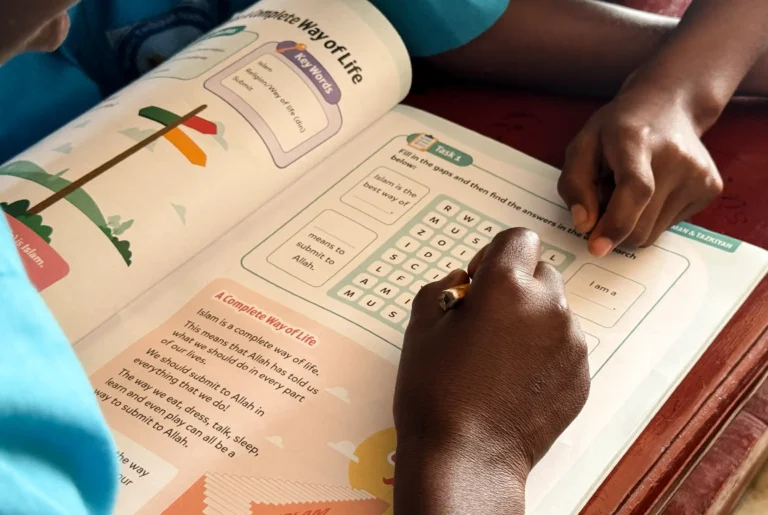
The concept of devoted worship to Allah, known as ʿubudiyyah, is essential for kids to learn alongside acts of worship. Check out Fiqh and ʿUbudiyyah books by Quranic Tarbiyah to see how we incorporate the ‘secrets’ (wisdoms) when teaching the pillars of Islam.
Quranic Tarbiyah: A Holistic Vision
The vision of the Quranic Tarbiyah curriculum is not merely to help children recite the Qur’an or learn its meanings. Rather, it seeks to nurture individuals who live by its guidance and embody its values.
By prioritising understanding alongside practice, young Muslims are equipped with spiritual depth, conviction, and purpose. They learn not only what Islam teaches, but why those teachings matter.
Both the ‘why’ and the ‘how’ are essential in Islamic education. By fusing both into what we teach our learners, we lay the foundations that, by the permission of Allah, can withstand doubts, challenges, and the complexities of modern life.
This is what raising children who love Islam truly requires: teaching the ‘why’ alongside the ‘how’. If we wish to nurture a generation that loves Allah, cherishes worship, and remains steadfast upon the dīn, then we must follow the Qur’anic pedagogy: by teaching the ‘why’ alongside the ‘how’.
Reflect
- How often do I teach why we worship Allah, not just how to worship Him?
- What is one lesson I have taught that could become more meaningful by including the wisdoms of the sharīʿah?
- Which is more important to you: the ‘why’ or the ‘how’?